
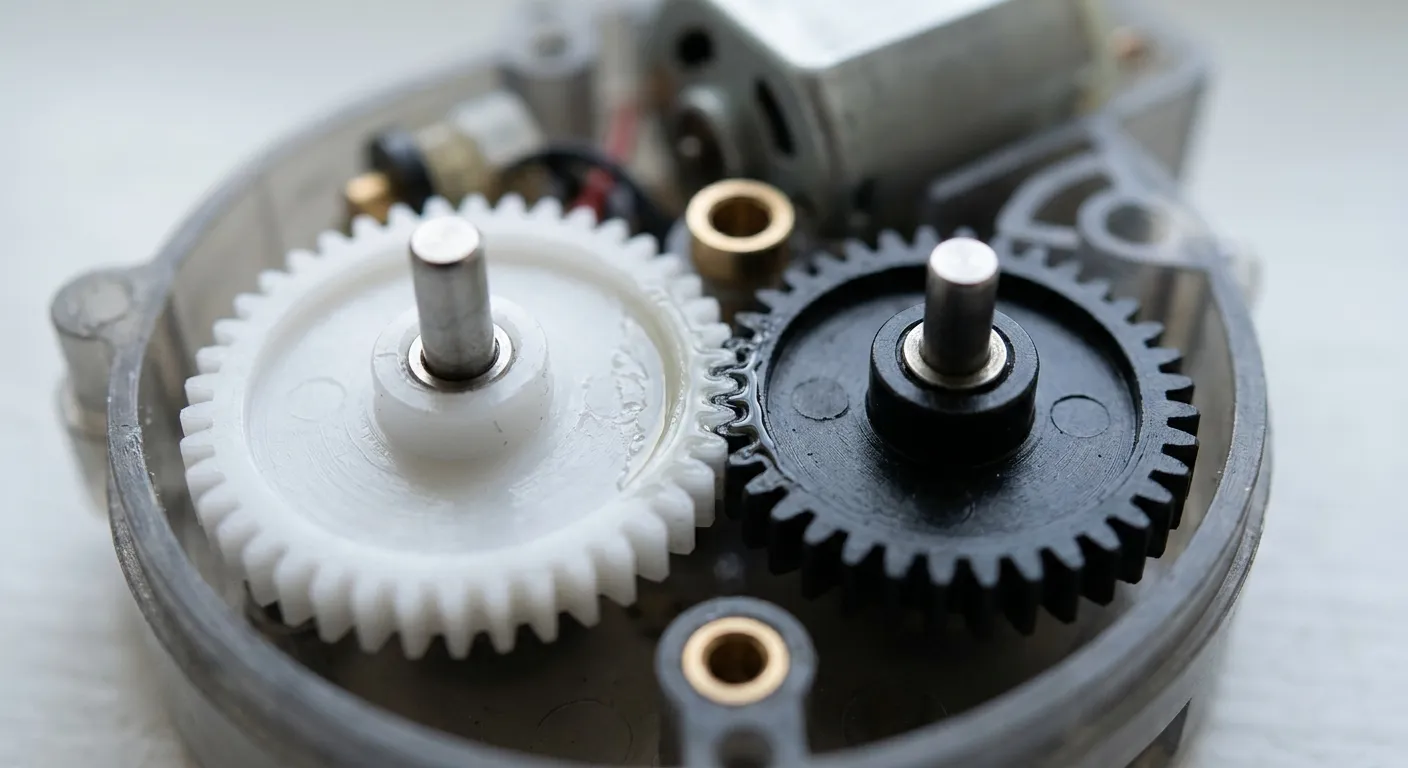
Nylon vs Acetal (POM) for Gears and Mechanical Parts
By Ichiplas Design Engineering Team · Nov 2026 · Reviewed by the Ichiplas engineering team
The two workhorse plastics for gears, bushings, clips and moving parts look similar but behave very differently, above all when humidity changes.
The short answer
Choose acetal (POM) for precision gears, clips and sliding parts that must hold tight tolerances, run with low friction or flex repeatedly, especially in humid or wet conditions. Choose nylon for parts that take shock loads, run hotter than about 100 °C or need a flame rating, and glass-filled nylon for maximum strength. For meshing gears, pairing the two often beats using either alone.
Acetal and nylon are the default choices for molded mechanical parts: gears, bushings, rollers, cams, clips, latches and fasteners. Both are strong, wear-resistant engineering plastics, and both are easy to mold. The deciding difference is usually water. Nylon absorbs moisture from the air, which changes its size, stiffness and toughness; acetal barely does. Get that wrong, and a gear that meshed perfectly at inspection can bind after a humid summer.
Nylon vs Acetal: Property Comparison
Typical values for unfilled injection molding grades. Nylon's properties depend heavily on how much moisture it has absorbed, so values are shown dry (as molded) and conditioned (in equilibrium with normal room humidity) where it matters.
| Property | Acetal (POM) | Nylon (PA6 / PA66) |
|---|---|---|
| Dimensional stability | Excellent | Fair: parts grow as they absorb moisture |
| Moisture absorption at 50% RH | About 0.2% | About 2.5–3% |
| Moisture absorption at saturation | About 0.8% | About 8–9% |
| Tensile strength | About 60–70 MPa | About 75–85 MPa dry; about 50–60 MPa conditioned |
| Stiffness | High, and stable with humidity | High when dry; roughly halves when conditioned |
| Impact toughness | Moderate | Good when conditioned; lower when dry |
| Friction | Very low; smooth, slippery surface | Low |
| Wear resistance | Excellent | Excellent |
| Fatigue resistance | Excellent, ideal for springs and repeated snaps | Good |
| Maximum service temperature | About 100 °C | About 120 °C (PA6) to 150 °C (PA66) |
| Chemical resistance | Excellent against solvents, fuels and oils; attacked by strong acids and chlorine | Good against oils, fuels and many solvents; attacked by strong acids |
| Flame-retardant grades | Not practical | UL 94 V-0 grades available |
| Glass-filled grades | Available but less common | Very common |
| Mold shrinkage | 1.8–2.5% (high) | 0.8–1.5% (unfilled) |
| Density | About 1.41 g/cm³ | 1.13–1.15 g/cm³ |
| Relative cost | $$ | $$ |
When to Choose Each Material
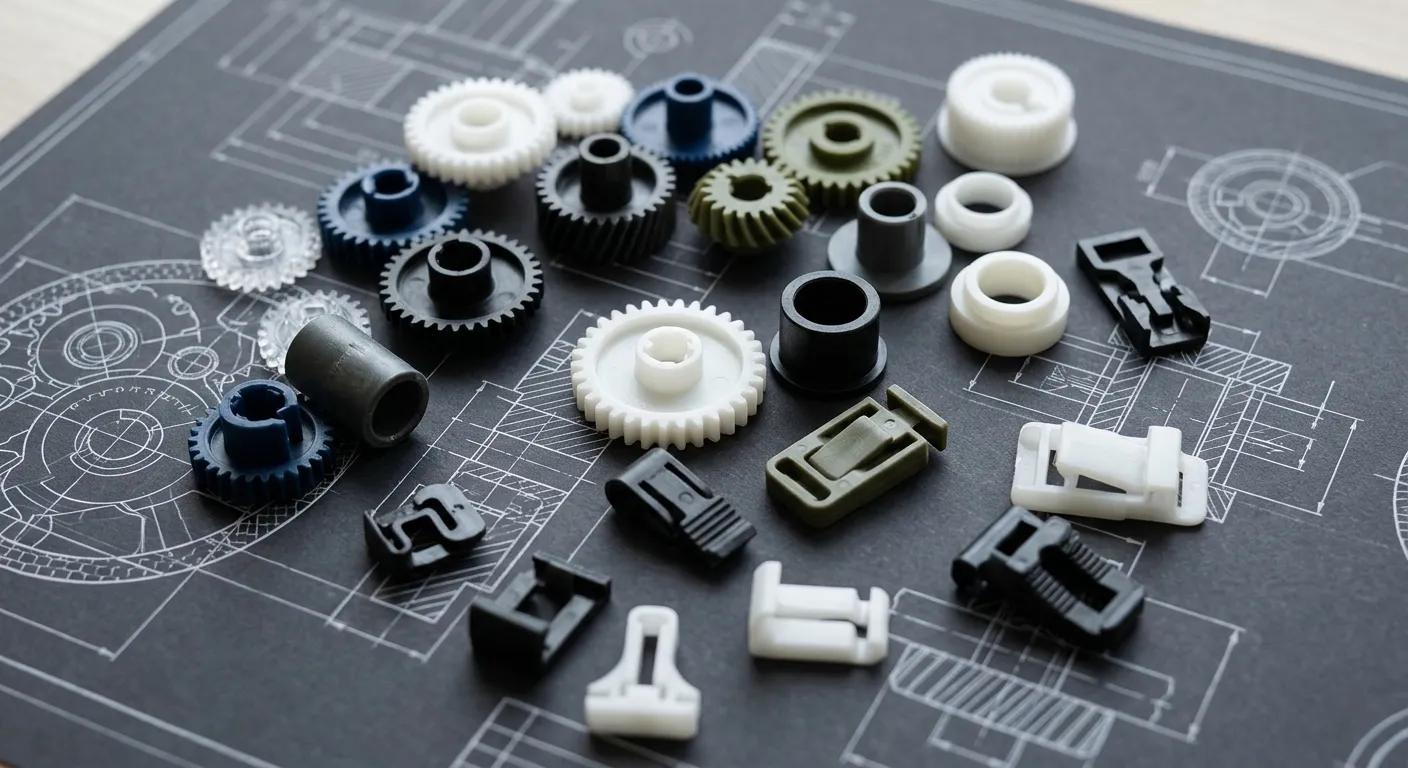
Acetal (POM): precision, low friction and stability
Acetal is stiff, hard and naturally slippery, with outstanding fatigue resistance and almost no moisture absorption. That makes it the first choice for precision gears, cams, rollers, zipper sliders, spring clips, latches and fuel system components, where dimensions must stay consistent and surfaces slide smoothly. Its limits are a high mold shrinkage that the mold design must compensate for, a service temperature of about 100 °C, poor UV resistance and no practical flame-retardant grades.
Nylon (PA6 and PA66): toughness, heat and reinforcement
Nylon is tougher than acetal, handles higher temperatures (especially PA66), and takes glass fiber and flame-retardant additives readily, so it covers a wider range, from cable ties and bushings to power tool gears and glass-filled structural brackets. Its weakness is moisture: it absorbs water from the air, growing slightly and becoming tougher but less stiff. Designs need to allow for that change, and parts should be measured in a known moisture condition.
Quick Chooser
| If your part needs… | Choose | Why |
|---|---|---|
| Tight tolerances in a humid or wet environment | Acetal (POM) | Absorbs very little moisture, so dimensions stay put |
| Low friction and quiet sliding | Acetal (POM) | Naturally slippery, low coefficient of friction |
| Repeated flexing: springs, clips, latches | Acetal (POM) | Outstanding fatigue resistance |
| Shock loads or impact | Nylon | Tougher, especially once conditioned |
| Continuous use above about 100 °C | Nylon (PA66) | Higher heat resistance |
| Maximum strength and stiffness | Glass-filled nylon | Glass fill greatly increases stiffness and strength |
| A flame rating | Nylon (FR grade) | Acetal cannot be effectively flame-retarded |
| Contact with chlorinated water or strong acids | Neither: consider PBT, PP or a specialist resin | Both are attacked |
Designing and Molding Plastic Gears
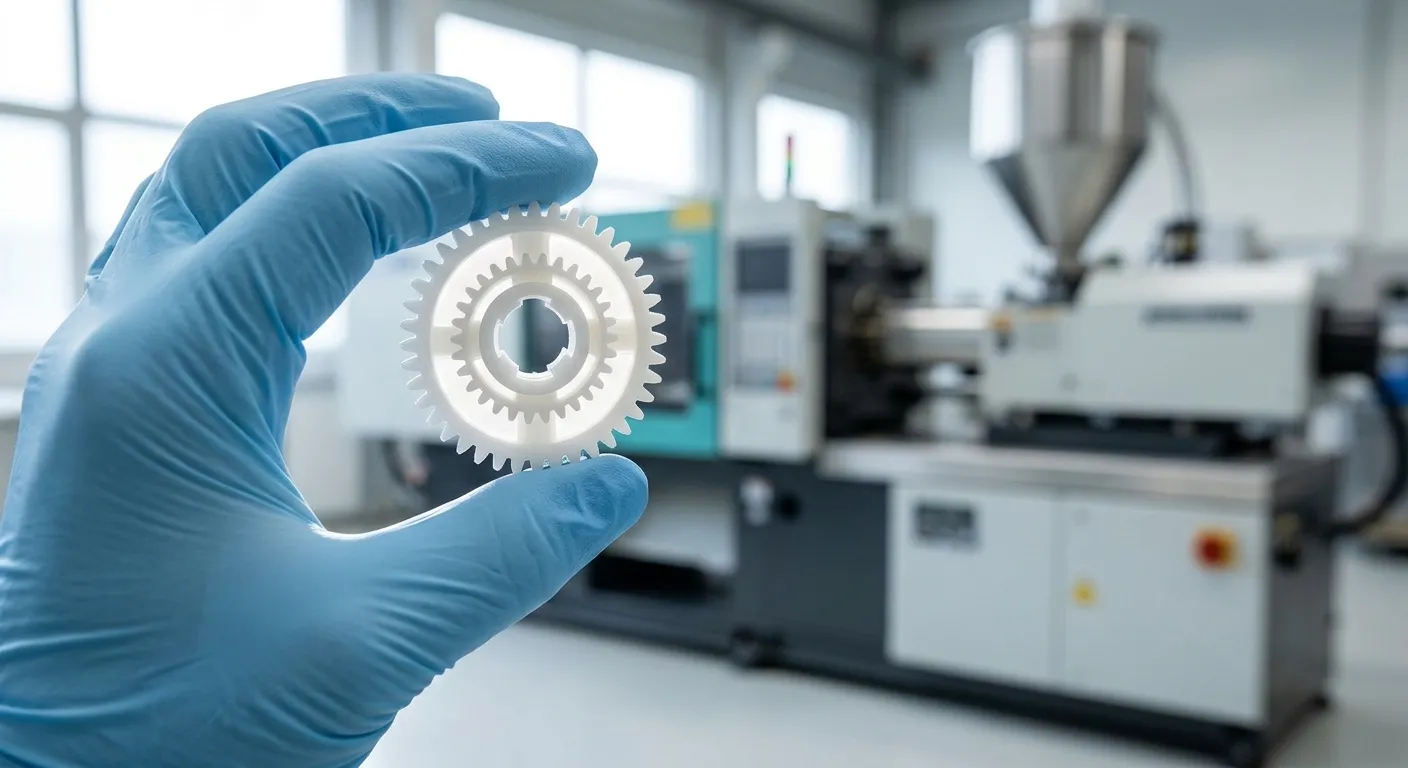
- Gate at the center. A diaphragm gate or three or more evenly spaced pin gates (in a three-plate mold) fill every tooth evenly and keep the gear round. A single side gate tends to make gears oval and puts a weld line in the teeth.
- Keep the rim, web and hub uniform. Thick hubs and solid gear bodies shrink unevenly and distort the tooth profile. Core out the web and keep sections consistent, as in our wall thickness guide.
- Allow for growth and expansion. Plastics expand with heat far more than steel, and nylon also grows with moisture. Add enough backlash and center-distance tolerance for the hottest and most humid conditions the product will see.
- Round the base of every tooth. The “root” is the bottom of the gap between two teeth, where each tooth joins the gear body. Bending stress is highest there, so a sharp corner is where a plastic tooth cracks first. Specifying a rounded, full-radius root instead spreads that stress and lets each tooth carry more load. This is standard practice in plastic gear design.
- Compensate for shrinkage in the mold. Acetal shrinks about twice as much as nylon. Gear cavities are cut oversize to the material's specific shrinkage, which is why switching materials in an existing gear mold rarely works.
- Measure nylon in a known condition. Agree whether nylon gears are inspected dry as molded or after moisture conditioning, because the dimensions differ.
Filled and Lubricated Grades
- Glass-filled nylon greatly increases stiffness, strength and heat resistance, and reduces moisture-related growth. Glass makes the surface more abrasive, so it is less suited to gears running against unfilled plastics.
- PTFE- or silicone-lubricated grades of both materials lower friction and wear further for unlubricated sliding parts.
- Impact-modified grades improve toughness, at some cost to stiffness.
Pairing Gears: Why Mixing Materials Works
Two gears of the same plastic running together tend to wear faster, generate more heat and can be noisier than a mixed pair. The most common combination is acetal against nylon. In a gear train driven by a metal pinion, the plastic gear is often the larger, driven gear, where its lower stiffness helps absorb shock and reduce noise. Plastic gears can usually run without lubrication, though a small amount of compatible grease at assembly often extends life significantly.
Understanding Nylon Moisture Conditioning
Nylon parts come out of the mold almost completely dry, when they are at their stiffest and most brittle. Over days to weeks they absorb moisture from the air until they reach equilibrium with the surrounding humidity. As a rough guide, each 1% of absorbed moisture can make an unfilled nylon part grow by about 0.2–0.3% in size. Some products are deliberately conditioned after molding (for example in a humidity chamber or by soaking) so they reach a stable, tougher state before assembly or shipment. Whatever the approach, design and inspection should both refer to the same moisture condition.
Other Materials for Molded Gears
Acetal and nylon cover most molded gears, but they are not the only options. PBT offers good dimensional stability and low moisture absorption with flame-retardant grades available. For very high temperatures or loads, high-performance polymers such as PPS and PEEK are used, at a much higher cost. Where loads exceed what any plastic can carry, a metal gear, or a plastic gear molded over a metal insert, is the answer. Our interactive material selector can help narrow the field.
Molding Gears and Mechanical Parts at Ichiplas
Ichiplas molds acetal, nylon (PA6 and PA66) and glass-filled grades for mechanical parts, and can mold gears over metal inserts where extra strength is needed. Every part we quote goes through a DFM analysis before any steel is cut, and if you haven't settled on a material yet, we can recommend one based on your requirements during the quotation process.
Send us your CAD files, operating conditions and annual volume via our contact page, and we'll quote the tooling and parts.
Frequently Asked Questions
Is nylon or acetal better for gears?
Acetal (POM) is usually better for precision gears, because it absorbs very little moisture, holds tight tolerances, has low friction and excellent fatigue resistance. Nylon is better for gears that see shock loads or higher temperatures, and glass-filled nylon for the highest strength. Many gear trains use both: a nylon gear running against an acetal gear wears and runs more quietly than two gears of the same material.
What is the difference between POM and nylon?
POM (acetal) is a stiff, slippery plastic with excellent dimensional stability and fatigue resistance that absorbs almost no water. Nylon (polyamide, PA6 or PA66) is tougher and more heat resistant, and available in glass-filled and flame-retardant grades, but it absorbs moisture, which changes its dimensions, stiffness and strength.
Does nylon absorb water?
Yes. Unfilled PA6 and PA66 absorb about 2.5–3% moisture in normal room humidity and up to about 8–9% when saturated. As they absorb moisture, nylon parts grow slightly, become tougher, and lose stiffness and strength. Designs must allow for this, especially for gears, snap-fits and press-fits.
Is acetal the same as Delrin?
Delrin is a brand name for acetal homopolymer. Acetal, POM and polyoxymethylene all refer to the same family of plastics, which comes as homopolymer and copolymer grades. Homopolymer is slightly stiffer and stronger; copolymer has better resistance to hot water and alkalis and is easier to process.
Why should two meshing plastic gears be made from different materials?
Gears of the same plastic running against each other tend to wear faster and can be noisier, because similar materials adhere and generate more heat at the contact. Pairing dissimilar materials, most commonly acetal against nylon, reduces wear and noise. A plastic gear running against a steel gear is also a common and effective combination.
Can acetal be glass-filled or flame-retardant?
Glass-filled acetal grades exist but are less common than glass-filled nylon, because glass reduces acetal's main advantages of low friction and smooth wear. Acetal cannot be effectively flame-retarded, so if a part needs a UL 94 V-0 rating, nylon or another flame-retardant material is normally chosen instead.
How do you injection mold a precision plastic gear?
Precision gears are usually gated at or near the center, with a diaphragm gate or several evenly spaced pin gates, so plastic flows evenly to every tooth and the gear stays round. Uniform rim and web thickness, mold compensation for the material's shrinkage, tight process control and, for nylon, measuring parts after moisture conditioning are all essential.
Get Free Quote
Contact us today to learn more about our services and how we can help you with your next project.