
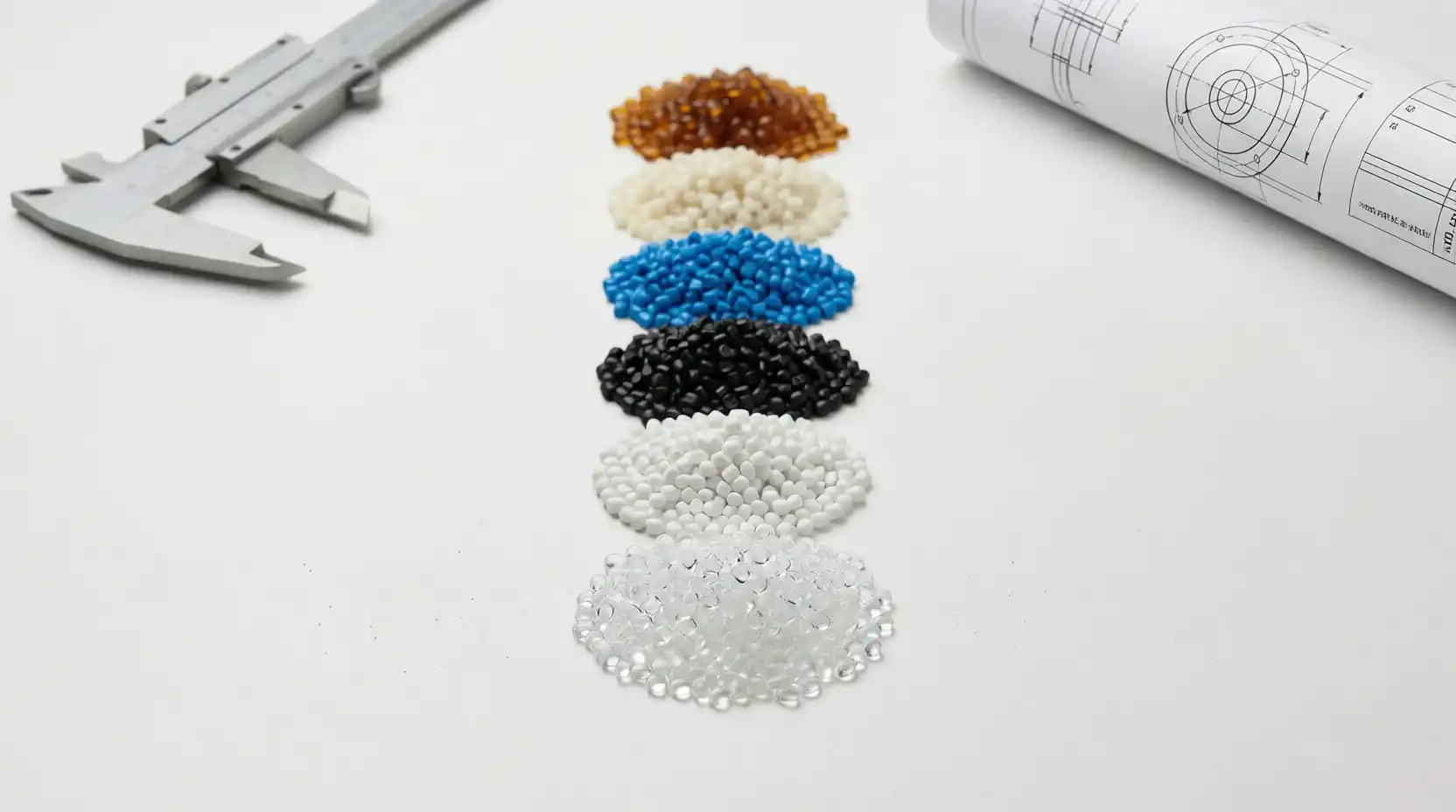
How to Choose the Right Plastic for Injection Molding
By Adrian Lim, Applications / DFM Engineer · Apr 2026 · Reviewed by the Ichiplas engineering team
A practical guide to material selection — with an interactive tool to find the best match for your part.
KEY FACTS: Injection Molding Material Selection
- The 12 most common injection molding plastics fall into two categories: rigid thermoplastics (PC, PC/ABS, ABS, PP, PS, HDPE, POM, PBT, Nylon) and flexible elastomers (TPE, TPU, TPV).
- Material selection is driven by five factors: operating temperature, mechanical requirements, chemical exposure, cosmetic appearance, and cost.
- The cheapest common plastics are PS, PP, and HDPE. The highest-performance are PC, Nylon, and PBT.
- Flexible materials vary significantly: TPE is cheapest and easiest to process, TPU has the best abrasion resistance, and TPV has the best heat and chemical resistance.
- Material choice affects mold design — some plastics require higher-grade mold steel, longer cooling times, or mandatory pre-drying before processing.
Why Material Selection Matters
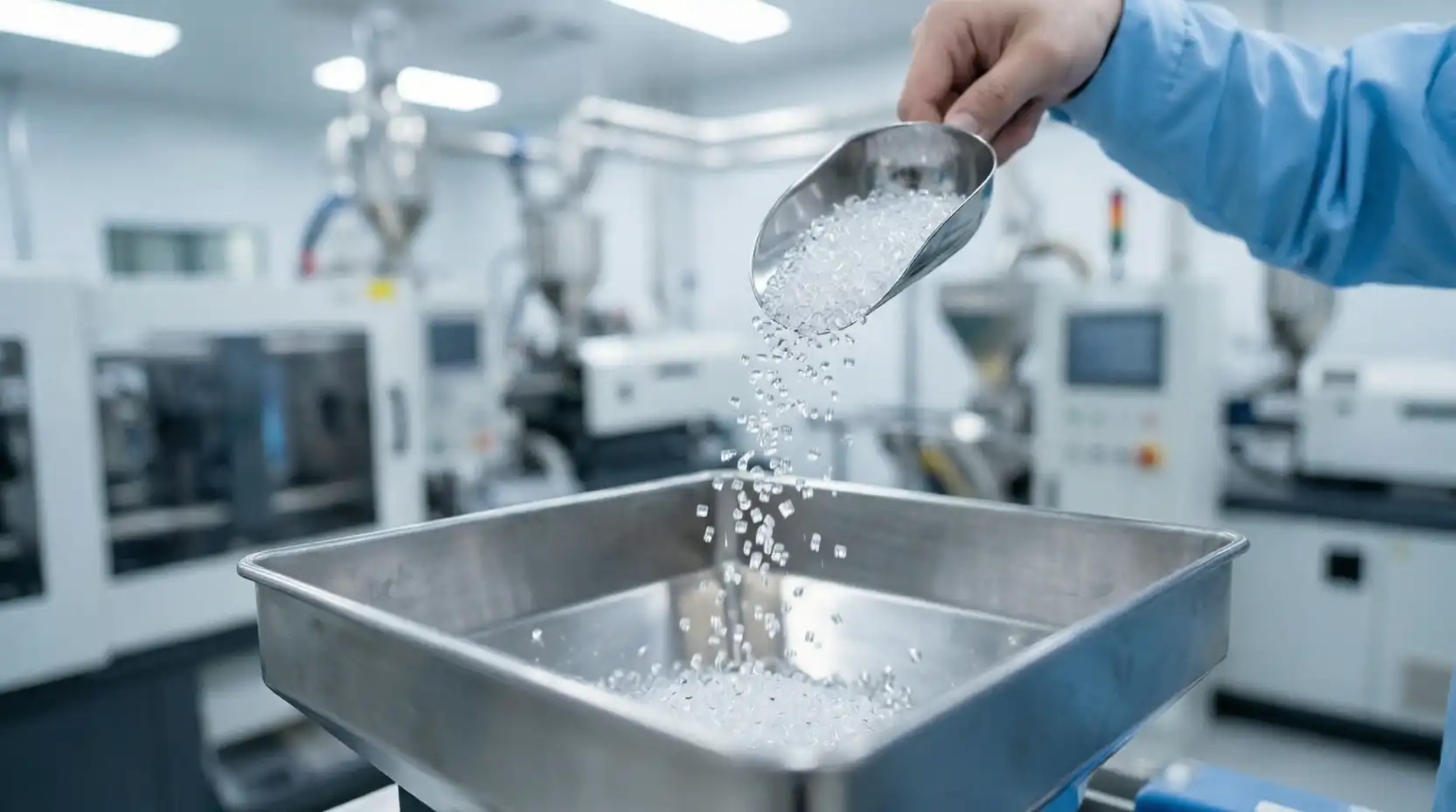
The plastic you choose determines how your part performs, what it costs to produce, and how it's manufactured. Getting material selection right early in the design phase saves tooling rework and production headaches. Getting it wrong means mold modifications, production delays, or — in the worst case — field failures that force a redesign.
Material selection typically happens before a supplier is chosen, which is why having a structured framework matters. The right material depends on your part's function, the environment it'll operate in, its appearance requirements, and your production volume. There is no single “best” material — every plastic is a set of trade-offs.
This guide covers the 12 most common general-purpose injection molding plastics. Specialty engineering resins (PEEK, PEI, LCP, PPS, PMMA, etc.) are not included — if your application may require these, contact us and our engineering team will recommend the right option.
Rigid vs Flexible — The First Decision
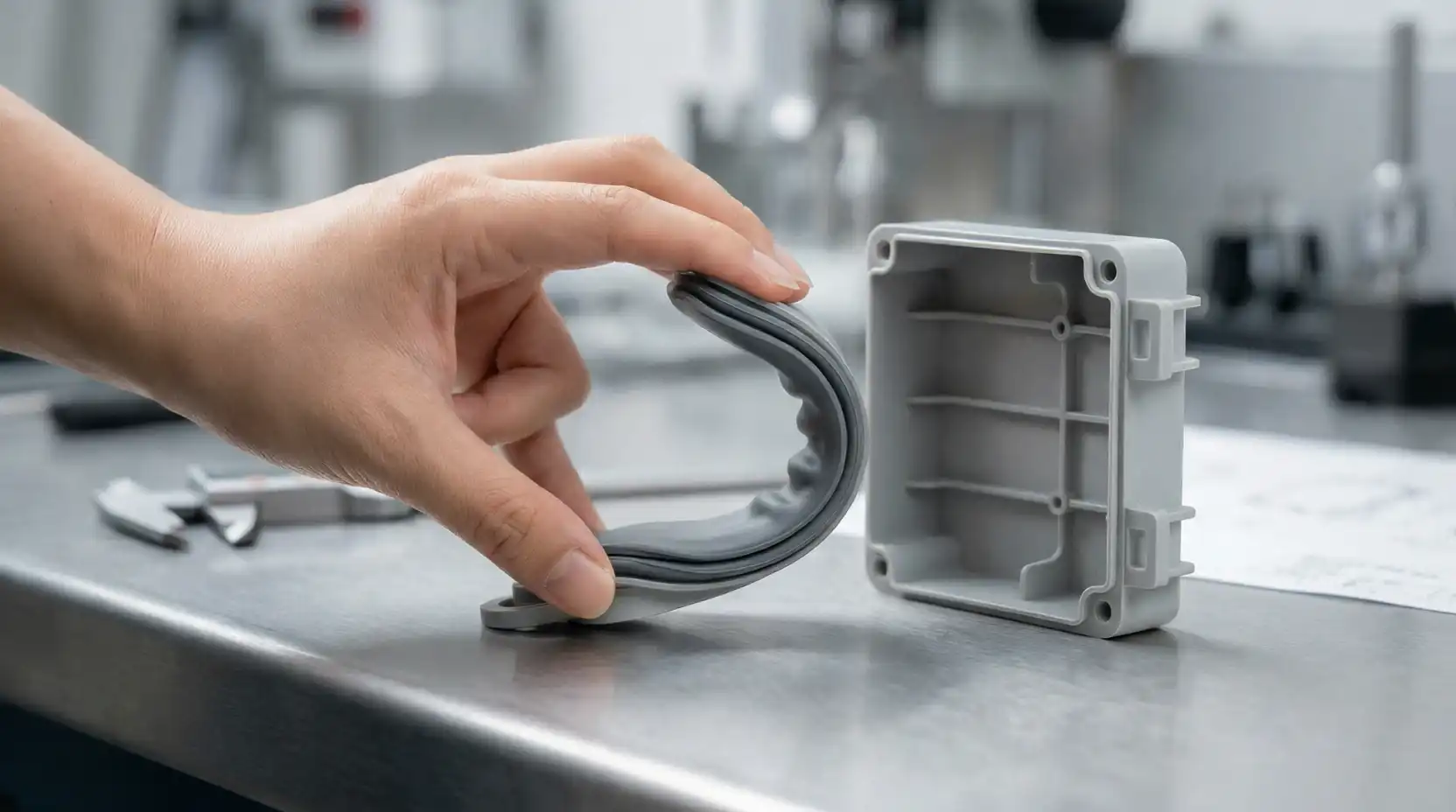
The single most important question is whether your part needs to be rigid or flexible. This splits the material universe into two distinct families with different properties, processing requirements, and cost structures.
Rigid thermoplastics — PC, PC/ABS, ABS, PP, PS, HDPE, POM, PBT, and Nylon — are used for structural parts, enclosures, housings, brackets, gears, and connectors. These materials resist deformation under load and maintain their shape over time.
Flexible elastomers — TPE, TPU, and TPV — are used for grips, seals, gaskets, vibration damping, and overmolding. These materials are rubber-like: they deform under load and spring back to their original shape.
Many products use both — a rigid housing with a soft-touch overmolded grip, for example. In that case, you're selecting two materials, and their overmolding compatibility becomes critical. TPE bonds well with ABS, PC, and PP. TPU bonds with PC, PC/ABS, and Nylon. TPV bonds only with PP.
The Five Factors That Drive Material Selection
1. Operating temperature. Below 80°C, all 12 materials work — you have maximum choice. At 80–120°C, ABS, PS, and TPE drop out. Above 120°C, your options narrow to PC, Nylon, PBT, and TPV. A kitchen appliance housing near a heating element needs at least 100°C tolerance — that alone rules out ABS.
2. Mechanical requirements. Impact resistance favours PC and PC/ABS for rigids, TPU for flexibles. Stiffness and structural strength point to Nylon (especially glass-filled), PC, and PBT. For gears and sliding mechanisms, POM is the default choice — its low friction and wear resistance are best-in-class among rigid thermoplastics.
3. Chemical and environmental exposure. PP, HDPE, POM, and TPV have excellent chemical resistance. ABS, PS, and TPE are vulnerable to solvents and oils. For UV and outdoor exposure, most plastics degrade without stabilisers — PC (with UV stabiliser), HDPE, and TPV are the better options. Nylon stands apart for moisture absorption: parts swell 1–2% in humid environments, which affects tolerances. PBT is the low-moisture alternative for similar applications.
4. Cosmetic appearance. ABS, PC/ABS, PC, and PS deliver the best surface finishes — high-gloss, paintable, and chrome-plateable. PC and PS (GPPS) offer optical clarity. PP and HDPE are difficult to finish — their non-polar surfaces resist paint and adhesive without surface treatment.
5. Cost. PS, PP, and HDPE are the cheapest commodity resins. ABS, POM, PBT, PC/ABS, Nylon, TPE, and TPV sit in the mid-range. PC and TPU are premium. But material cost per kilogram is only part of the picture — cycle time, scrap rate, and post-processing needs all affect total part cost. PP and PS have the fastest cycles; PC and TPU require drying and run slower.
How Material Choice Affects Your Mold
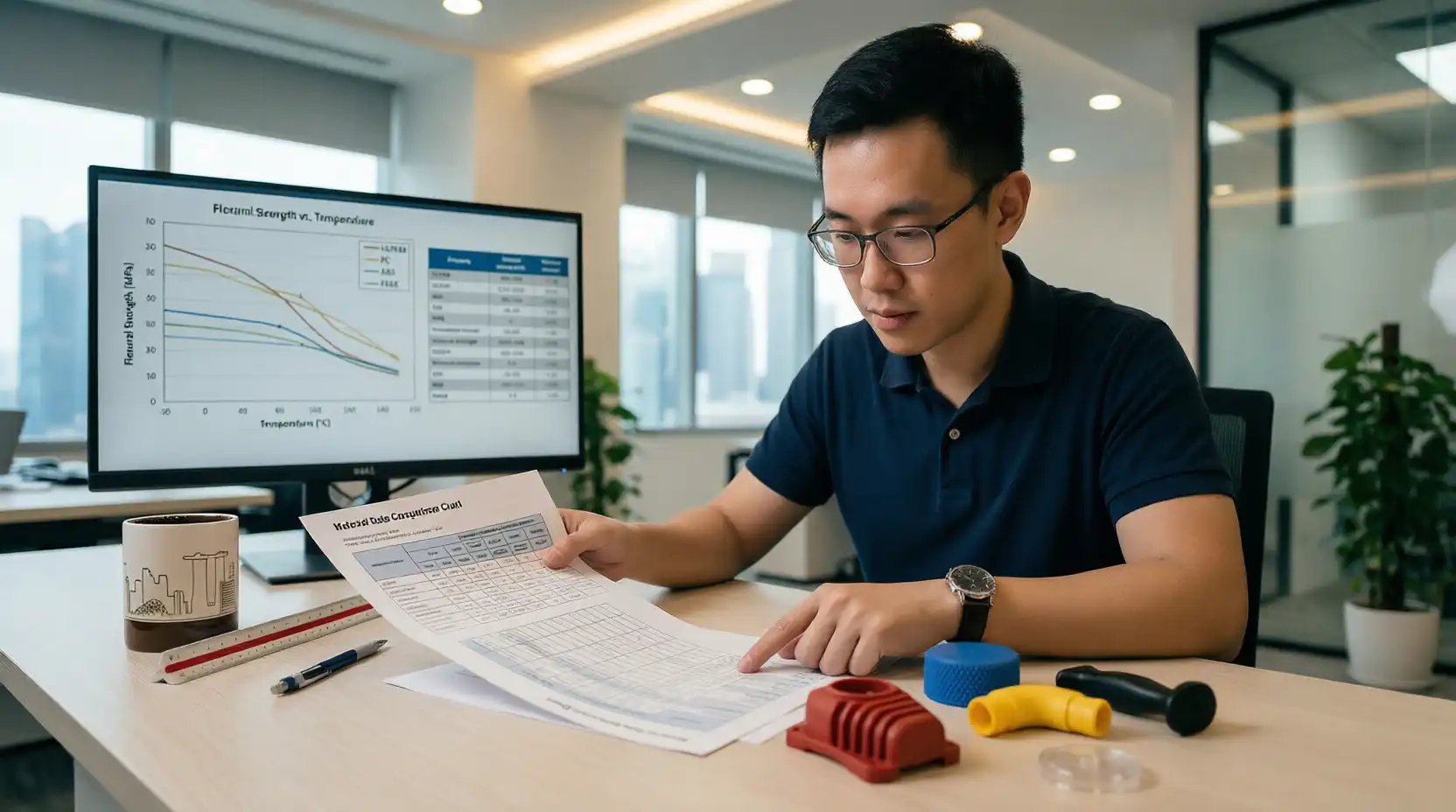
Material selection doesn't just affect the part — it affects the mold design and cost. Glass-filled materials like Nylon GF and PBT GF are abrasive and require high-grade mold steel (8407 ESR or equivalent), increasing tooling cost by 50–100%.
High-shrinkage materials — PP at 1–2.5%, HDPE at 1.5–3%, POM at 1.8–2.5% — require more sophisticated mold compensation than low-shrinkage materials like PS (0.3–0.6%) or ABS (0.4–0.7%). Several materials require drying before processing (PC, Nylon, PBT, TPU), which affects cycle planning. Understanding these interactions between material and tooling upfront prevents costly surprises later in the project.
The selector below covers 12 common injection molding plastics. Answer a few questions about your part's requirements, and it will show you which materials fit — with full property comparisons so you can evaluate the trade-offs.
Frequently Asked Questions
What plastic material is best for consumer electronics enclosures?
PC, PC/ABS, and ABS are the most common materials for electronics enclosures. PC offers the best impact resistance and optical clarity. PC/ABS provides a good balance of impact strength and processability at lower cost. ABS is the most economical option with excellent surface finish for painted or plated parts.
What is the cheapest plastic for injection molding?
PS (polystyrene), PP (polypropylene), and HDPE are typically the lowest-cost injection molding materials. PS is the cheapest and easiest to mold, with GPPS offering crystal clarity. PP is the lightest common thermoplastic with excellent chemical resistance. HDPE is extremely tough and chemical-resistant but difficult to achieve cosmetic finishes.
What is the difference between TPE, TPU, and TPV?
All three are flexible, rubber-like materials that can be injection molded. TPE is the most economical and easiest to process, best for soft-touch grips and cosmetic applications. TPU offers the best abrasion and oil resistance but costs more and requires drying. TPV has the highest heat and chemical resistance (up to 135°C), making it ideal for automotive seals and industrial gaskets.
What plastic material can withstand high temperatures?
For rigid parts above 120°C, polycarbonate (PC) handles up to ~130°C, PBT up to ~130°C (higher with glass fill), and Nylon (PA66) up to ~150°C. For flexible parts, TPV withstands up to ~135°C continuous use. Glass-filled Nylon and PBT grades can exceed 200°C for short periods.
What is the best material for gears and bearings?
POM (acetal/Delrin) is the default choice for gears, bearings, and sliding mechanisms due to its excellent wear resistance, low friction, and dimensional stability. Nylon is an alternative when higher impact strength is needed, but absorbs moisture which affects dimensions. For heavily loaded gears, glass-filled Nylon or PBT may be preferred.
Which materials are suitable for overmolding?
For soft-touch overmolding on rigid substrates, TPE bonds well with ABS, PC, PP, and PS. TPU bonds well with PC, PC/ABS, and Nylon. TPV bonds only with PP (same polymer family). POM has limited overmolding compatibility and must never be combined with PVC. Material compatibility must be confirmed for each specific application.
Which materials are suitable for electrical connectors?
PBT (often glass-filled) is the global standard for electrical connectors due to its excellent dimensional stability, low moisture absorption, good heat resistance, and widely available UL94 V-0 flame-retardant grades. Nylon is also used but its higher moisture absorption can be problematic in precision connector applications.
This tool covers common general-purpose injection molding plastics only. Specialty engineering resins (PEEK, PEI, LCP, PPS, PMMA, etc.) are not included — contact us if your application may require these. Properties shown are typical ranges for standard injection molding grades and are intended as a general guide. Actual performance depends on specific grade, wall thickness, part geometry, processing conditions, and environmental exposure. Ichiplas can recommend specific material grades for your application — contact us with your part details.
Related reading: Part 1: Tooling Fundamentals | Part 4: Tooling Cost Guide
Get Free Quote
Contact us today to learn more about our services and how we can help you with your next project.