
ABS vs PC vs PC/ABS: Choosing the Right Plastic for Your Housing
By Ichiplas Design Engineering Team · Nov 2026 · Reviewed by the Ichiplas engineering team
Three of the most common plastics for enclosures and housings, compared on the properties that decide which one your part actually needs.
The short answer
Choose ABS for cost-sensitive indoor parts that need a good finish or chrome plating. Choose PC when you need transparency, the highest impact strength or heat resistance up to about 130 °C. Choose PC/ABS for tough, often flame-rated electronics and appliance housings, where you need more than ABS offers but not the cost or processing demands of pure PC.
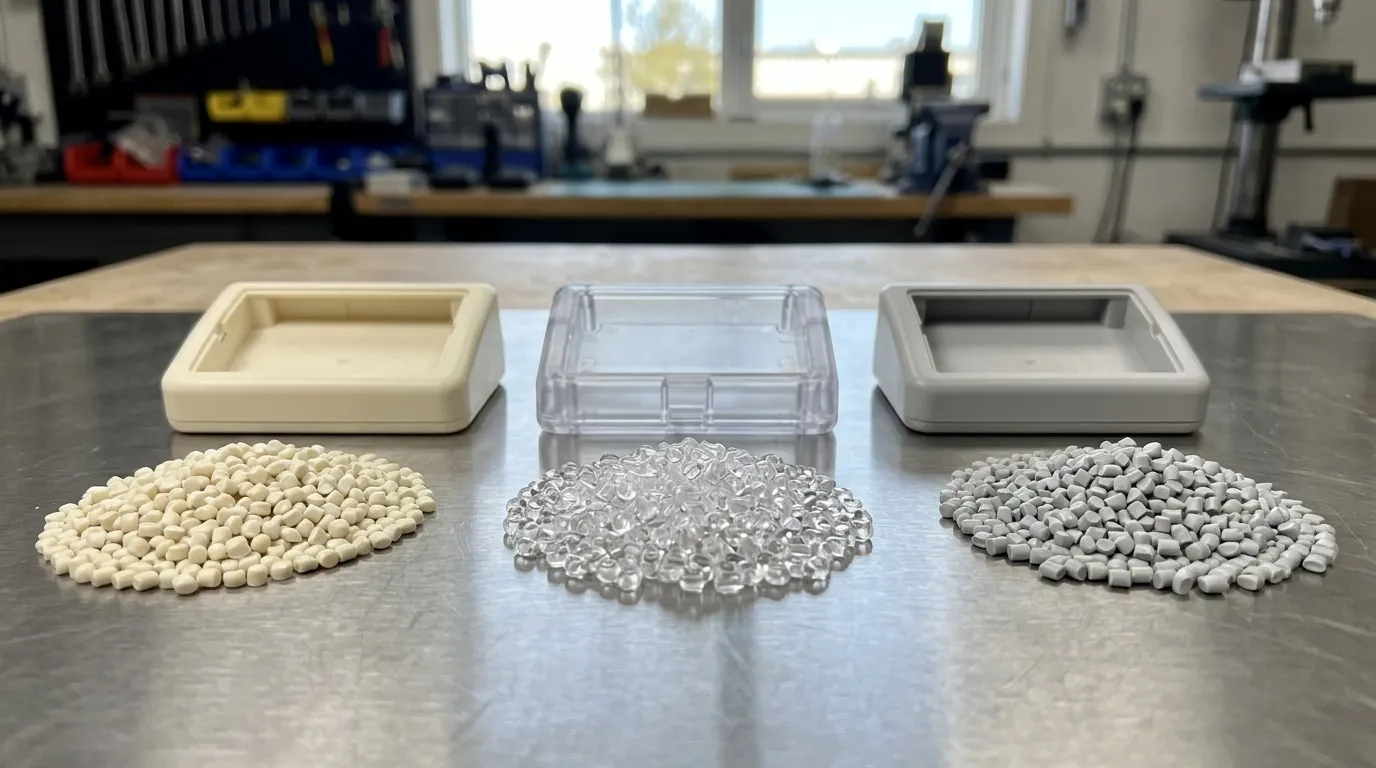
ABS, polycarbonate and their blend, PC/ABS, cover a huge share of the housings, covers and enclosures around you, from remote controls to laptop bodies to appliance panels. They look similar as pellets and molded parts, but they behave very differently when dropped, heated, left in the sun or exposed to cleaning chemicals. Choosing the wrong one is one of the most common reasons a part passes prototype testing and then fails in the field.
ABS vs PC vs PC/ABS: Property Comparison
Typical values for unfilled, general-purpose injection molding grades. Individual grades vary widely, so confirm with the datasheet for the grade you specify.
| Property | ABS | PC/ABS | PC |
|---|---|---|---|
| Impact strength (notched Izod) | Good: about 150–400 J/m | High: about 400–650 J/m | Very high: about 600–900 J/m |
| Tensile strength | About 40–45 MPa | About 50–55 MPa | About 60–65 MPa |
| Maximum service temperature | About 80 °C | About 110 °C | About 130 °C |
| Transparency | Opaque | Opaque | Optically clear grades available |
| Density | 1.04–1.06 g/cm³ | 1.10–1.15 g/cm³ | About 1.20 g/cm³ |
| Mold shrinkage | 0.4–0.7% | 0.5–0.7% | 0.5–0.7% |
| UV resistance | Poor: yellows outdoors | Moderate | Good with UV stabiliser |
| Chemical resistance | Low to moderate | Moderate | Moderate; prone to stress cracking with some solvents |
| Flame-retardant (UL 94 V-0) grades | Available | Widely used | Widely used |
| Chrome plating | Excellent (plating grades) | Good (plating grades) | Difficult |
| Ease of molding | Easiest | Easy to moderate | More demanding: high melt temperature, notch-sensitive |
| Relative resin cost | $ | $$ | $$$ |
When to Choose Each Material
ABS: the cost-effective all-rounder
ABS is one of the most widely molded engineering plastics because it is affordable, easy to process and gives an excellent surface finish straight from the mold. It is the standard substrate for decorative chrome plating and paints well. Its limits are heat (around 80 °C), poor UV resistance and modest chemical resistance. Typical uses: indoor consumer products, appliance covers, toys, remote controls and interior trim.
PC: maximum toughness, clarity and heat resistance
Polycarbonate is the toughest of the three and the only one available in optically clear grades. It keeps its toughness in the cold and handles service temperatures of about 130 °C. In exchange, it costs more, needs higher processing temperatures, must be dried carefully and is notch-sensitive, so sharp corners and molded-in stress can lead to cracking. Typical uses: lenses and light guides, clear covers, safety equipment and high-impact housings.
PC/ABS: the balanced choice for enclosures
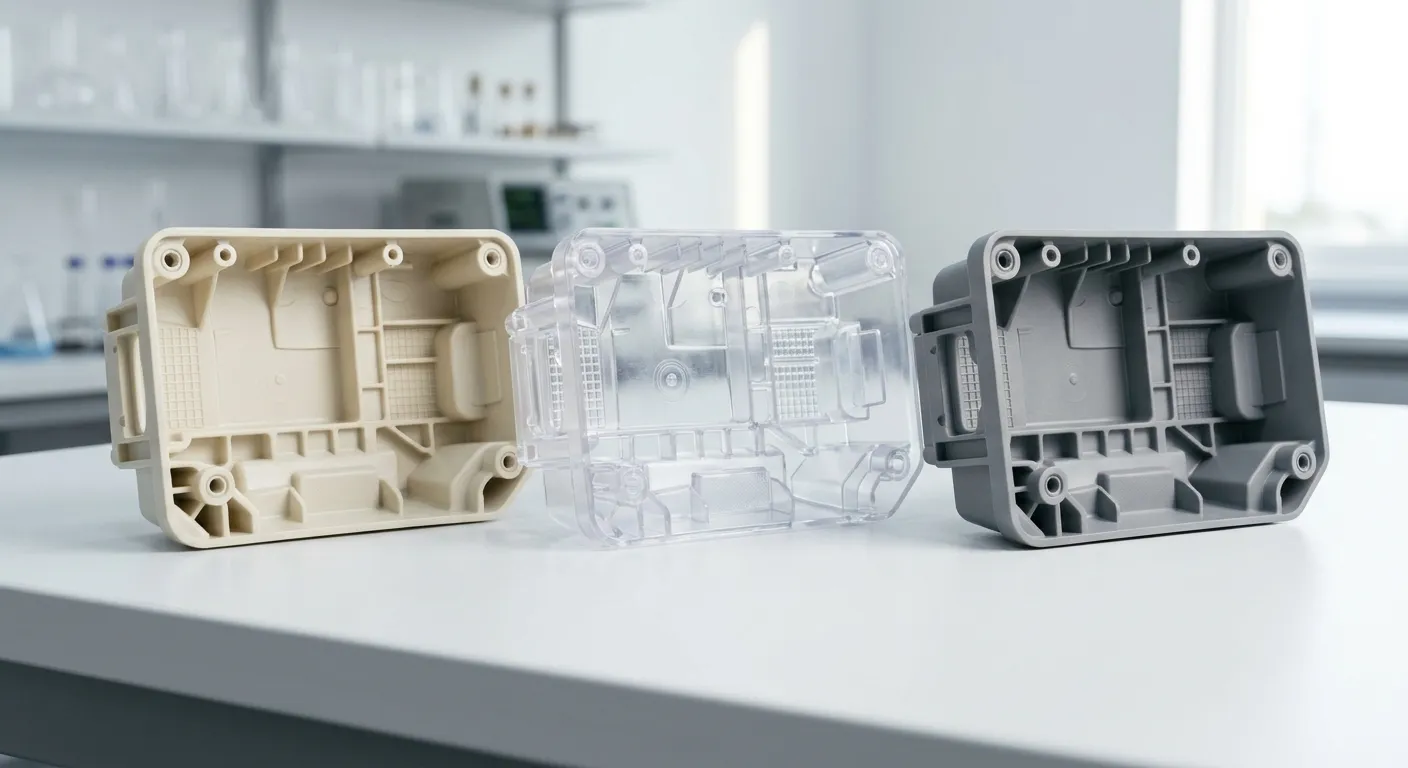
PC/ABS blends combine much of polycarbonate's toughness and heat resistance with the easier processing and lower cost of ABS. They are the default choice for many electronics and appliance housings, especially in flame-retardant (UL 94 V-0) grades. They are opaque, and their chemical and UV resistance are only moderate. Typical uses: laptop and printer housings, power tool bodies, chargers, instrument bezels and automotive interior panels.
Quick Chooser: Which One for Your Requirement?
| If your part needs… | Choose | Why |
|---|---|---|
| The lowest cost with a good finish | ABS | Cheapest of the three, easy to mold, excellent cosmetics |
| Chrome plating | ABS (plating grade) | The industry standard substrate for decorative chrome |
| Transparency | PC | The only one of the three available in clear grades |
| Maximum impact resistance, including in the cold | PC | Highest toughness; stays tough at low temperatures |
| Continuous use around 100 °C | PC | Highest heat resistance of the three |
| A tough, flame-rated electronics enclosure | PC/ABS (FR grade) | Strong balance of toughness, flame rating, finish and cost |
| Thin walls with a premium finish | PC/ABS | Flows better than PC, tougher than ABS |
| Outdoor exposure | UV-stabilised PC | Standard ABS and PC/ABS fade and yellow in sunlight |
Design Tips for Each Material
- Radius every internal corner, especially in PC. A fillet of at least half the wall thickness greatly reduces stress concentration in notch-sensitive polycarbonate.
- Keep walls uniform. All three materials typically run well between about 1.2 and 3.5 mm. See our wall thickness guide for material-specific ranges.
- Design snap-fits for the material. ABS tolerates the least strain, so snap-fit beams need to be longer or thinner than in PC.
- Test with real chemicals. Cleaning products, hand creams, greases, threadlockers and adhesives can cause stress cracking, particularly in PC and PC/ABS. Test molded parts under load with the chemicals they will actually meet.
- Plan for drying. All three must be dried before molding; PC needs the most. A molder that skips this produces splay marks and brittle parts.
How They Differ on the Molding Floor
| Processing factor | ABS | PC/ABS | PC |
|---|---|---|---|
| Drying before molding | About 80 °C for 2–4 hours | About 90–110 °C for 3–4 hours | About 120 °C for 3–4 hours |
| Typical melt temperature | 210–260 °C | 240–280 °C | 280–320 °C |
| Typical mold temperature | 50–80 °C | 60–90 °C | 80–120 °C |
| Snap-fit strain limit (one-time) | 2–2.5% | 2.5–3% | 3.5–4% |
Typical values; always follow the resin supplier's processing guide for the specific grade.
Alternatives Worth Considering
- HIPS (high-impact polystyrene) is cheaper than ABS for simple, low-stress indoor parts.
- PMMA (acrylic) is clearer and more scratch-resistant than PC, and cheaper, but far more brittle.
- PC/PBT blends add better chemical resistance, useful for automotive and outdoor equipment exposed to fuels and cleaners.
- Glass-filled PC or PC/ABS add stiffness and dimensional stability for structural parts, at the cost of surface finish and impact strength.
Not sure where to start? Our interactive material selector narrows the choice in four questions.
Specifying Flame-Retardant Grades
Mains-powered electronics and battery products often need housings rated to UL 94 V-0 or similar. Flame-retardant grades of all three materials exist, with FR PC/ABS the most common for enclosures. Two details matter: the rating applies at a stated thickness, so check the grade is rated at your thinnest wall; and FR grades cost more and can be slightly less tough than standard grades. Many brands now also specify halogen-free FR systems. See our guide to plastic applications and standards for more on UL 94.
Plating, Painting and Decoration
For a bright chrome finish, plating-grade ABS is the standard choice and plating-grade PC/ABS is used where more toughness or heat resistance is needed; pure PC is difficult to plate. All three can be spray painted, pad printed and laser marked, though paints and inks must be chosen to avoid stress cracking in PC. Ichiplas offers chrome plating, spray painting, pad printing and laser marking alongside molding.
Recycled and Lower-Carbon Grades
Post-consumer recycled (PCR) grades of ABS, PC and PC/ABS are now widely available, and many electronics brands specify a minimum recycled content for housings. PCR grades can vary more from batch to batch in color and properties, so specify the grade, recycled content and acceptable color range up front and validate them at the sample stage.
Need Help Choosing?
Ichiplas molds ABS, PC and PC/ABS every day, including flame-retardant and plating grades, along with related materials such as HIPS and PC/PBT, for customers including Dyson and Shimano. Every part we quote goes through a DFM analysis before any steel is cut, and if you haven't settled on a material yet, we can recommend one based on your requirements during the quotation process.
Send us your CAD file and a short description of the part's environment via our contact page, and we'll quote the tooling and parts, recommending a material if you haven't chosen one yet.
Frequently Asked Questions
What is the difference between ABS, PC and PC/ABS?
ABS is an affordable, easy-to-mold plastic with a good surface finish but limited heat and UV resistance. Polycarbonate (PC) is much tougher, more heat resistant and available in clear grades, but costs more and is harder to mold. PC/ABS is a blend that sits between them, combining much of PC's toughness and heat resistance with ABS's easier processing and lower cost.
Is PC/ABS stronger than ABS?
Yes. PC/ABS typically has higher impact strength, tensile strength and heat resistance than ABS, which is why it is widely used for laptop housings, power tool bodies and electronics enclosures that must survive drops. It costs more than ABS but less than pure polycarbonate.
Is polycarbonate better than ABS?
Polycarbonate is tougher, more heat resistant and can be transparent, so it is better for demanding applications. ABS is cheaper, easier to mold, takes chrome plating better and is perfectly adequate for many indoor consumer products. 'Better' depends on whether your part actually needs PC's extra performance.
Can PC/ABS be transparent?
No. PC/ABS blends are opaque. If you need a clear part, polycarbonate is the usual choice among these three materials; acrylic (PMMA) or transparent MABS are lower-cost alternatives when impact resistance is less critical.
Which is better for outdoor use: ABS, PC or PC/ABS?
Of the three, UV-stabilised polycarbonate performs best outdoors. Standard ABS yellows and becomes brittle in sunlight, and PC/ABS is only moderately better. If an ABS or PC/ABS part must be used outdoors, specify a UV-stabilised grade or protect it with a UV-resistant paint or coating.
Can I switch from ABS to PC/ABS without a new mold?
Often, yes. ABS and PC/ABS have similar shrinkage, so many molds can run PC/ABS with process adjustments for its higher melt and mold temperatures. Switching to pure PC is less straightforward because of its higher processing temperatures and notch sensitivity. Always run trial shots and check dimensions before committing.
Why do polycarbonate parts crack?
Polycarbonate is very tough but notch-sensitive and prone to environmental stress cracking. Common causes are sharp internal corners, high molded-in stress, contact with incompatible solvents, cleaners, adhesives or plasticisers, and inadequate drying before molding. Generous radii, proper drying and testing with the actual chemicals the part will meet prevent most failures.
Get Free Quote
Contact us today to learn more about our services and how we can help you with your next project.