
Shipping Plastic Parts from Malaysia: What to Expect
By Daniel Tan, Sourcing & Commercial Lead · Jan 2026 · Reviewed by the Ichiplas engineering team
A practical guide to transit times, freight options, customs, and logistics for injection molded parts from Malaysia.
You've found a capable injection molding partner in Malaysia. The tooling is approved, first articles look good, and production is underway. Now comes the question that every procurement manager and supply chain lead needs answered: how do the parts actually get to you?
Shipping from Southeast Asia isn't complicated — but it is different from domestic freight, and the details matter. Transit times, Incoterms, HS codes, packaging standards, and customs documentation all affect your landed cost, your inventory planning, and your ability to clear goods without delays.
This guide covers what to expect when shipping injection molded plastic parts from Malaysia to the United States and the United Kingdom — based on how we actually ship at Ichiplas, not theoretical logistics textbooks.
Where We Ship From
Ichiplas is based in Johor Bahru, at the southern tip of Peninsular Malaysia. This location gives us direct access to two major shipping hubs:
Port of Pasir Gudang — a deep-water port approximately 30 minutes from our factory. This is our primary port for containerised sea freight. It handles both FCL (Full Container Load) and LCL (Less than Container Load) shipments with regular sailings to the US West Coast, US East Coast, and the UK.
Port Klang — Malaysia's largest port, located near Kuala Lumpur. Some shipping lines offer more frequent sailings or better rates from Port Klang, particularly for LCL consolidation. Transit from our factory to Port Klang is approximately 3–4 hours by road.
For air freight, we use Senai International Airport (JHB) in Johor Bahru or Kuala Lumpur International Airport (KUL), depending on airline availability and cost.
Transit Times
Transit times depend on the destination, the shipping method, and whether you're shipping FCL or LCL. Here are the typical ranges based on our actual shipment history.
Sea Freight
| Destination | Port | Transit Time |
|---|---|---|
| US West Coast | Los Angeles / Long Beach | 18–25 days |
| US Gulf Coast | Houston | 25–30 days |
| US East Coast | New York / New Jersey | 28–35 days |
| United Kingdom | Felixstowe / Southampton | 25–32 days |
These are port-to-port transit times. Add 3–7 days for customs clearance and inland delivery on the destination side, and 2–3 days for export processing on our side.
Air Freight
| Destination | Transit Time |
|---|---|
| US (any major airport) | 3–5 days |
| UK (Heathrow / East Midlands) | 3–5 days |
Freight Options
FCL (Full Container Load). If your order fills a 20-foot or 40-foot container, FCL is the most cost-effective option. You get a sealed container from our factory to your warehouse, with no handling of individual cartons in transit. A standard 20-foot container holds approximately 25–28 CBM (cubic metres) or up to 21,000 kg. FCL rates from Malaysia to the US West Coast typically range from USD 2,500–5,000 per container depending on season and carrier.
LCL (Less than Container Load). For smaller shipments — typically under 15 CBM — LCL consolidation is the practical choice. Your cargo is combined with other shippers' goods in a shared container. LCL rates are charged per CBM (typically USD 80–150 per CBM from Malaysia to the US), with a minimum charge of 1 CBM. LCL adds 5–10 days to total transit time compared to FCL due to consolidation and deconsolidation at both ends.
Air freight. Air freight makes sense when speed outweighs cost — typically for first article samples, urgent replacement parts, or low-volume high-value components. Rates from Malaysia to the US run approximately USD 4–8 per kg, with a minimum charge of around 45 kg. A shipment of 200 kg of plastic parts would cost roughly USD 800–1,600 by air versus USD 200–400 by sea (LCL).
Air express (courier). For very small shipments — sample parts, prototypes, or urgent deliveries under 30 kg — express courier services (DHL, FedEx, UPS) offer door-to-door delivery in 2–4 days. Rates are higher (USD 8–15 per kg) but include customs brokerage and delivery. Ichiplas regularly ships first article samples via express courier.
Packaging and Palletisation
How parts are packed matters as much as how they're shipped. Injection molded parts can be scratched, cracked, or deformed if packaging isn't designed for the transit environment — especially for sea freight, where containers experience vibration, humidity, and temperature swings over 3–5 weeks.
At Ichiplas, packaging is engineered as part of the production process, not an afterthought. Our standard packaging approach includes:
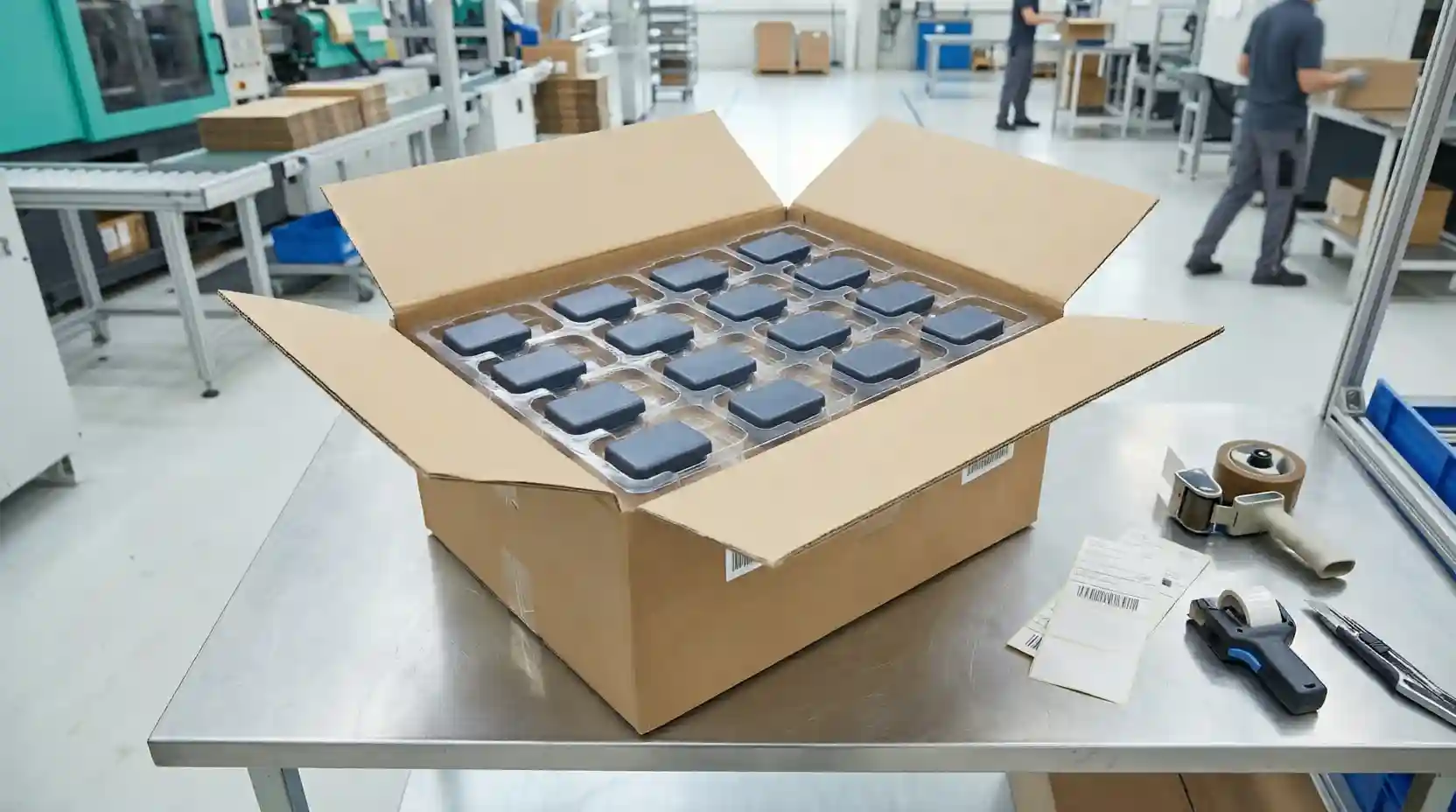
Inner packaging. Parts are placed in custom vacuum-formed trays or PE bags depending on the part geometry and cosmetic requirements. Cosmetic parts (visible surfaces, textured finishes) are individually separated to prevent contact marks.
Carton packaging. Inner-packed parts are placed in double-wall corrugated cartons, sized to minimize movement during transit. Cartons are labelled with part number, quantity, gross and net weight, and carton number.
Palletisation. Cartons are stacked on standard pallets (typically 1200 x 1000 mm or 48 x 40 inch) and stretch-wrapped. For FCL shipments, pallets are loaded directly into the container at our factory. For LCL, pallets are delivered to the consolidation warehouse.
If your parts have specific packaging requirements, we accommodate these as part of the production specification.
Customs, HS Codes, and Import Duties
Customs clearance is where many first-time importers encounter friction. The process is straightforward once you understand the classification system and have the right documentation — but errors in HS code assignment or missing paperwork can cause delays and unexpected costs.
HS Code Classification
Every product crossing an international border is assigned a Harmonized System (HS) code — a standardised numerical code used by customs authorities worldwide to classify traded goods. The HS code determines the duty rate applied to your import.
Most injection molded plastic parts fall under HS Chapter 39 (Plastics and articles thereof). The most common subheading for custom injection molded components is 3926.90 — “Other articles of plastics and articles of other materials of headings 39.01 to 39.14.” However, the exact HS code depends on the part's function, material, and end use. For example, a plastic gear may be classified under HS 8483 (machine parts) rather than HS 3926, because the classification follows function, not material.
Ichiplas provides the HS code classification on all commercial invoices. We recommend that you confirm the classification with your customs broker before the first shipment, as reclassification after entry can trigger audits or retroactive duty adjustments.
US Import Duties
For the United States, most injection molded plastic parts under HS 3926.90 carry a standard MFN (Most Favoured Nation) duty rate of 5.3%. Malaysia is not currently subject to the additional Section 301 tariffs that apply to goods imported from China, which makes Malaysian-sourced parts more cost-competitive on a landed-cost basis for many product categories.
Important: Duty rates can change based on trade policy. The 5.3% rate is current as of the publication date of this article. We recommend:
- Confirm the current rate with your customs broker or via the US Harmonized Tariff Schedule before committing to pricing.
- Factor duty into your landed cost when comparing quotes from suppliers in different countries.
- Work with a licensed customs broker for your first import to ensure correct classification and smooth clearance.
UK Import Duties
For the United Kingdom, the standard duty rate for HS 3926.90 is 6.5%. Goods from Malaysia enter under standard MFN terms. VAT at 20% is applied on the CIF value plus duty. UK importers should also be aware of the requirement to submit customs declarations through the Customs Declaration Service (CDS), which replaced the older CHIEF system.
Documentation Ichiplas Provides
A complete and accurate documentation package is the single most important factor in avoiding customs delays. Ichiplas provides the following with every shipment:
- Commercial invoice — with full part descriptions, HS codes, unit prices, and total value
- Packing list — with carton count, gross and net weights, and dimensions
- Bill of lading (sea) or airway bill (air)
- Certificate of origin — Form D (for ASEAN) or standard CO, as required by the destination country
- Material safety data sheets (MSDS) — where required by the material or destination regulations
- Compliance certificates — RoHS, REACH, UL, or other certifications as applicable to your product

Shipping Terms
We typically ship EXW (Ex Works) or FOB (Free on Board). Under EXW, the buyer arranges collection from our facility and takes responsibility from that point. Under FOB, Ichiplas delivers the goods to the port of departure, and the buyer takes responsibility and cost from there. Other Incoterms are available by arrangement. We recommend discussing shipping terms during the quotation stage so logistics costs are clear from the start.
Planning Your Timeline
The most common mistake in offshore procurement is underestimating total lead time. Production time is only one component. Here's a realistic breakdown of the full timeline from order to delivery, assuming sea freight to the US West Coast:
| Phase | Duration |
|---|---|
| Production | 10–20 days (depends on volume) |
| Packaging and export processing | 2–3 days |
| Sea transit (West Coast) | 18–25 days |
| Customs clearance and inland delivery | 3–7 days |
| Total estimated lead time | 33–55 days |
For the US East Coast or UK, add approximately 7–10 days to the sea transit phase. For air freight, replace the sea transit phase with 3–5 days but expect higher freight costs.
We recommend building a 1–2 week buffer into your planning for the first shipment. Once the supply chain is established and you've completed a few cycles, the timeline becomes highly predictable.
If you're evaluating Malaysia as a source for injection molded parts and want to understand the full landed cost — including tooling, part price, packaging, and freight — get in touch with our team. We'll provide a detailed estimate by the next business day. No commitment required.
Frequently Asked Questions
How long does it take to ship injection molded parts from Malaysia to the US?
Sea freight from Port Klang or Pasir Gudang to the US typically takes 18–25 days to the West Coast (Los Angeles/Long Beach), 25–30 days to the Gulf Coast (Houston), and 28–35 days to the East Coast (New York/New Jersey). Air freight takes 3–5 days to any major US airport.
What HS code applies to injection molded plastic parts?
Most injection molded plastic parts fall under HS Chapter 39 (Plastics and articles thereof). The most common subheading is 3926.90 — “Other articles of plastics and articles of other materials of headings 39.01 to 39.14.” However, the exact HS code depends on the part's function, material, and end use. Ichiplas provides the HS code classification on all commercial invoices.
What are the import duties on plastic parts from Malaysia?
For the US, most injection molded plastic parts under HS 3926.90 carry a standard MFN duty rate of 5.3%. Malaysia is not currently subject to additional Section 301 tariffs that apply to Chinese goods. For the UK, the standard duty rate for HS 3926.90 is 6.5%, and goods from Malaysia enter under standard MFN terms.
Does Ichiplas handle freight and shipping?
Ichiplas handles all export-side logistics including packaging, palletisation, export documentation, customs clearance, and coordination with freight forwarders. We ship FOB (Free on Board) as standard, meaning we deliver goods to the port of departure. We can also arrange CIF (Cost, Insurance, and Freight) or DAP (Delivered at Place) on request.
What documentation does Ichiplas provide for customs clearance?
Ichiplas provides a complete export documentation package: commercial invoice with HS codes, packing list with weights and dimensions, bill of lading or airway bill, certificate of origin (Form D for ASEAN or standard CO), material safety data sheets (MSDS) where required, and any compliance certificates (RoHS, REACH, UL) as applicable.
How do I get a shipping quote from Ichiplas?
Contact Ichiplas through our website at ichiplas.com/contact-us with your part details, estimated volumes, and destination. We will provide a landed-cost estimate covering tooling, part price, packaging, and freight by the next business day.
Get Free Quote
Contact us today to learn more about our services and how we can help you with your next project.